


A renovation of a private flat always special interior design project. These homes already possess a strong inherent character: high ceilings, well-proportioned rooms, classic details, walls steeped in history, and spatial relationships that operate at a different pace to those in a newly built flat.
The aim with a space like this is not to get rid of everything that’s old. Rather, it is to identify what is worth preserving, what needs to be subtly reinterpreted, and how the classic foundations can be adapted to modern lifestyles.
This was precisely the starting point for the Buda townhouse we are now presenting. The aim was to create a home that is at once elegant, tranquil, sustainable in the long term and deeply personal. Beige and oak tones, delicate stucco work and classic mouldings recur throughout the flat, whilst concealed storage, pocket door solutions, home office features and details tailored to pets are perfectly suited to modern-day living.
This project clearly demonstrates that the renovation of a private flat It is truly successful when we think not only in terms of visuals, but also in terms of real-life situations, routines, patterns of movement and long-term changes.
Why is renovating a private flat any different?
A private home has its own rhythm. The rooms are often larger, the walls have more character, and the windows and doors, the ceiling height and the layout all help to define the atmosphere of the space in their own right.
This is both a great opportunity and a great responsibility.
An opportunity, because these homes provide a wonderful foundation for a timeless, elegant interior. A responsibility, because excessive modernisation can easily strip away the character that makes a home truly special.
The aim of this project was therefore not to create a sterile, entirely new world. Rather, it was to design a cohesive home where classic details are preserved, whilst the functionality supports modern family life.
The stucco work, the wall sconces, the delicate mouldings and the built-in furniture all contribute to this transition. The space evokes the elegance of a bourgeois home, whilst every square centimetre serves a specific purpose.
1. A children’s bedroom designed for the long term
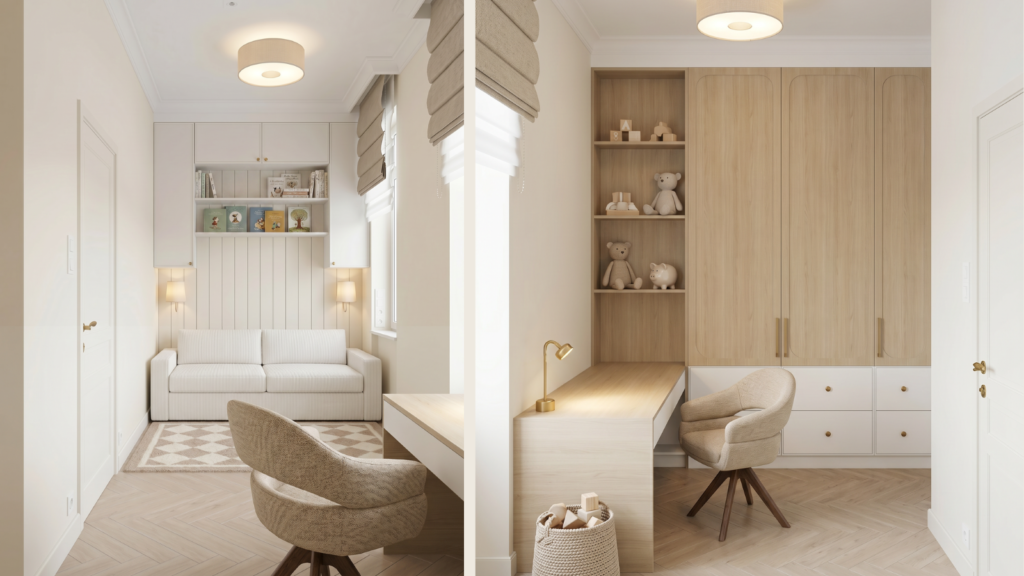
The presentation of the project began with the most personal space of all: the children’s room. This room is currently used as a guest room, but during the design phase we took into account that it could be transformed over time into a nursery, a room for a toddler, a child’s room, and eventually even a teenager’s room.
This is one of the most important considerations when planning your home thoughtfully: you need to take into account not only your current circumstances, but also how your family’s life might change in the coming years.
The room’s primary function is to accommodate a pull-out guest sofa. Later on, it can comfortably fit a cot, even with a changing table, and can then accommodate an 80- or 90-centimetre pull-out bed, which works well even during the early school years. And as the child gets older, the space can also accommodate a 140 or 160-centimetre bed.
When it came to built-in cupboards, it was particularly important to think long-term. Ideally, the frame can remain unchanged for years, whilst the fronts, decorative elements, wall colours or wallpaper can be more easily adapted to suit one’s current age and style.
The neutral, beige base offers great flexibility here. It does not tie the room down to a single mood or style, but creates the opportunity to take the space in any direction later on, using décor, textiles, paint or wallpaper.
This children’s bedroom isn’t designed for just a moment. It can grow alongside the child who will use it.
2. Two bathrooms, designed with a single concept in mind
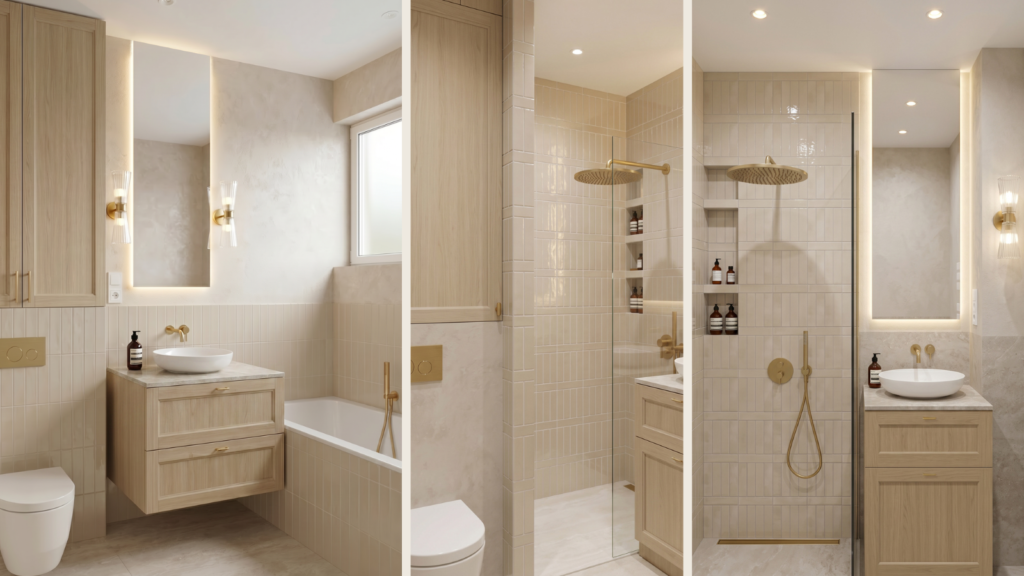
The original floor plan featured just a single bathroom with a bath. During the renovation, however, it was considered essential that the flat should have two separate bathing facilities: one with a bath and one with a shower.
The bathroom with a shower was created from a former storage room and a separate toilet. This clearly illustrates that, when renovating a private flat, rethinking the floor plan is at least as important as the choice of materials or the selection of furniture.
Every square centimetre here has been given a new purpose.
In the two bathrooms, the use of materials is deliberately based on the same principles, yet they each have a different atmosphere. This subtle distinction helps to ensure that the spaces do not feel repetitive, whilst still remaining part of a single narrative.
The creative use of different finishes, the treatment of recesses, the concealment of pipes and the integration of storage units all required special attention. In a room like this, it is often the least eye-catching details that determine just how peaceful and practical the end result will be.
The bathroom with a shower has also been given a special feature: it houses the cat litter tray, completely out of sight. This may seem like a minor detail, yet it says a great deal about the design philosophy. A home only really works when it caters to every member of the family – including the four-legged ones.
Storage has been given a prominent role in both bathrooms. The spaces above the toilets have also been utilised, and the built-in cupboards help to maintain the clean, calm overall look.
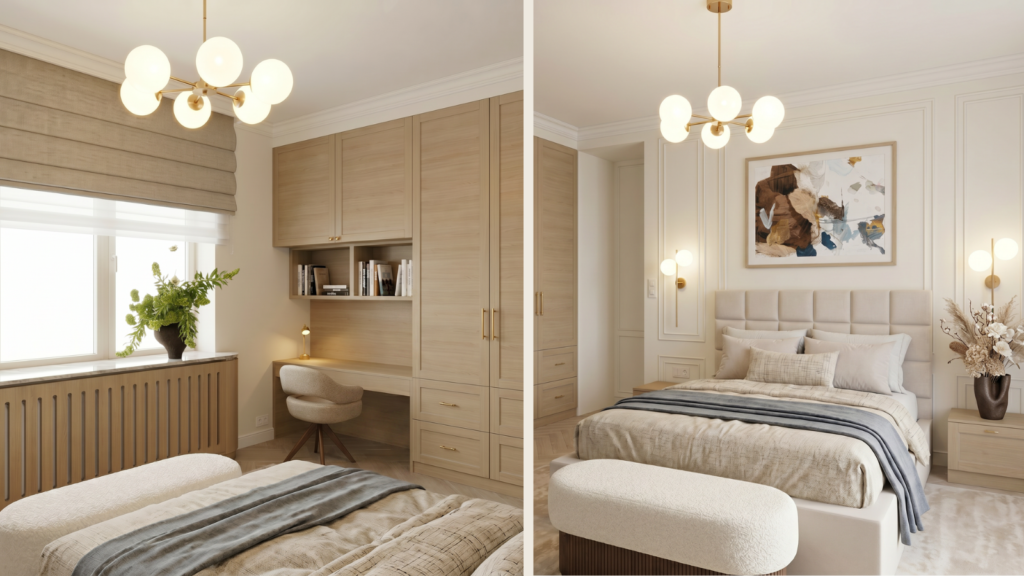
3. A master bedroom with classic design elements and a hidden home office feature
The master bedroom is one of the most peaceful spaces in the flat. The aim here was to create a timeless, classic foundation that is neither flashy nor over-the-top, yet remains elegant and personal.
The character of the private home set the tone all by itself. The understated stucco work, the delicate mouldings and the coffered ceilings provide a backdrop for the space that requires no excessive decorative elements.
This classic foundation is softened by a few more modern touches. With regard to the lighting in particular, it was important that the lamps should not merely be functional elements, but should also bring a fresher, lighter atmosphere to the space.
However, the bedroom was not designed solely for relaxation. The home office function also plays an important role in the life of the flat, but in such a way that it does not disrupt the tranquillity of the bedroom. The aim was not to create a strikingly separate work area, but rather a concealed yet fully-fledged workspace that can be used when needed, without dominating the room.
Open shelves give the overall look a more relaxed feel, whilst closed storage units and large built-in cupboards ensure that everyday items do not become the visual focus.
This room is a good example of how a bedroom is only truly well-designed if it promotes relaxation, tidiness and a layout suited to the occupant’s lifestyle.
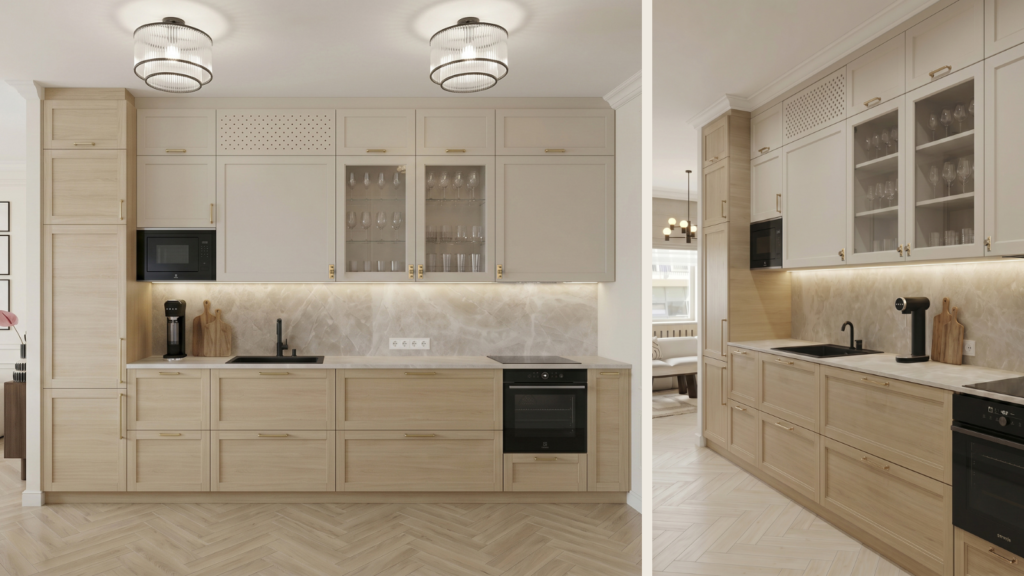
4. A kitchen where everything disappears when it’s not needed
The kitchen is one of the most important organisational elements of the flat as a whole. Here, too, shades of oak and beige dominate, defining the character of the home throughout, in accordance with the client’s specific request.
The aim was to create a kitchen that was visually uncluttered, yet highly functional. One of the key elements in achieving this was the design of the section of wall opposite, which features a built-in cupboard sliding door It turned out to be the solution. The entire range of appliances, the coffee machine and almost all the small kitchen appliances were moved into a lockable, concealed area.
This makes a huge difference in everyday life. It’s always to hand when you need it, but when it’s not in use, the space remains uncluttered.
The size of the worktop was also a key consideration in terms of functionality. Although the minimum distance between the sink and the hob is often the sole focus, a truly practical kitchen requires more than that. The aim was to ensure that the space between the two functions was not merely a technically adequate surface, but a comfortable work area that would stand up to everyday use.
Upon special request, the fridge was also fitted into the wall unit. This always requires mechanical engineering, and may involve compromises, but in this project it helped to ensure that the kitchen retained a cohesive, tidy and calm appearance.
The kitchen therefore does not function as a separate room, but is organically integrated into the flat as a whole.
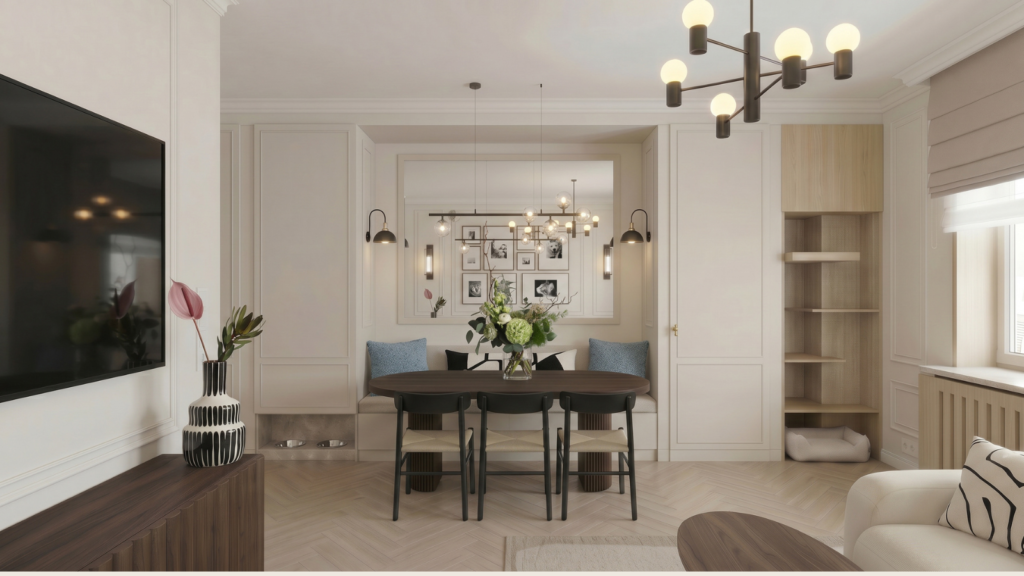
5. A dining room with hidden features and personal touches
In this project, the dining area is not merely a space organised around a table. Rather, it is one of the conceptual focal points of the flat.
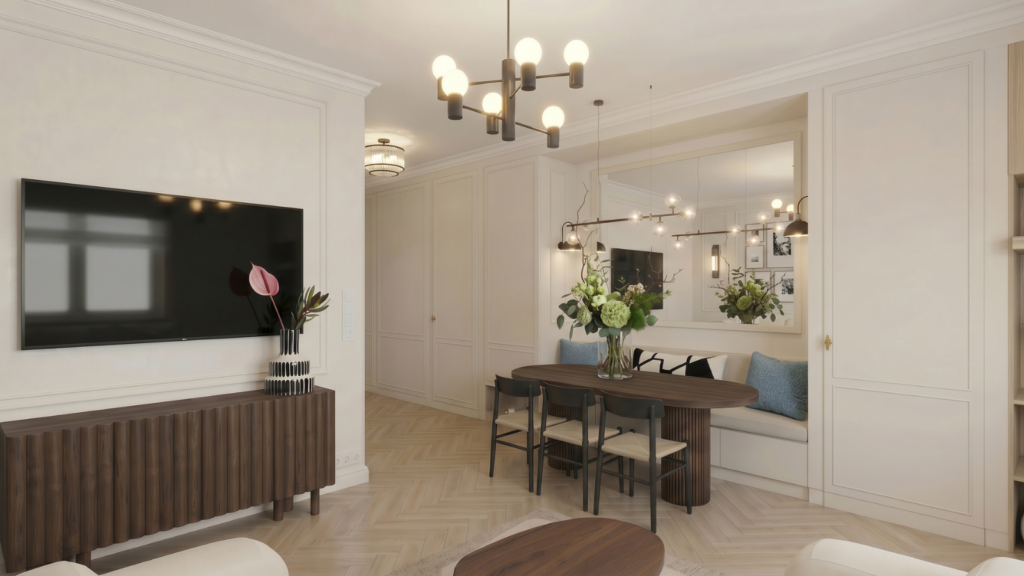
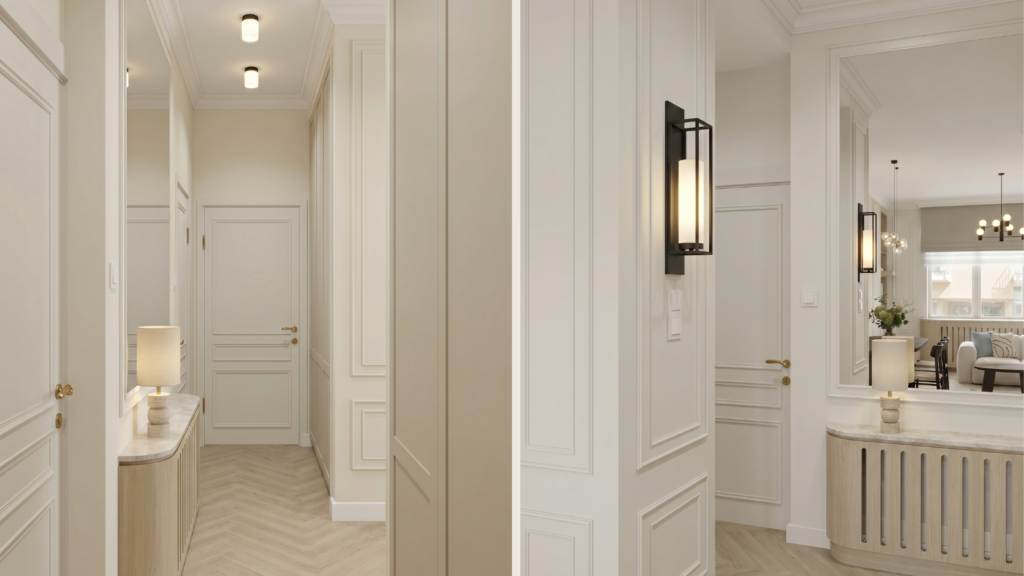
A continuous feature wall runs from the entrance hall, through the kitchen and all the way to the living room. This design both evokes the classic atmosphere of bourgeois homes and conceals the practical functions of a modern home.
Hidden behind the stuccoed surface are storage spaces, doors and passageways. Behind these „invisible doors” lie either a bathroom or a bedroom, whilst a significant proportion of the flat’s storage capacity is also accommodated within this system.
This approach to design is particularly exciting because it does not rely on the furniture being treated as separate elements. Instead, it treats storage as an architectural feature, so that its function does not weigh down the space.
The dining bench also serves as concealed storage. It’s a practical solution, yet it doesn’t detract from the airiness of the space. It is precisely this balance that makes the end result so appealing: the flat is not only beautiful, but also genuinely functional.
Special attention was paid to the space for our four-legged family members. A climbing and resting wall covered with a scratching surface was created for the cat, whilst at the bottom we fitted out a comfortable sleeping area for the dog. The water bowls are also concealed, integrated into the cupboard.
It is these details that really give the interior a personal touch. The solutions are not generic, but tailored specifically to this family and this home.
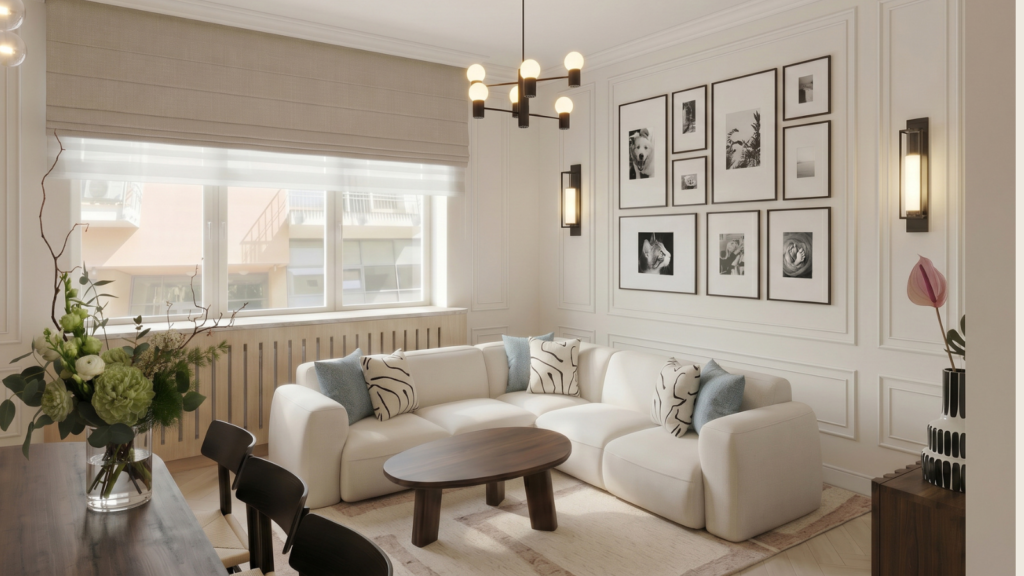
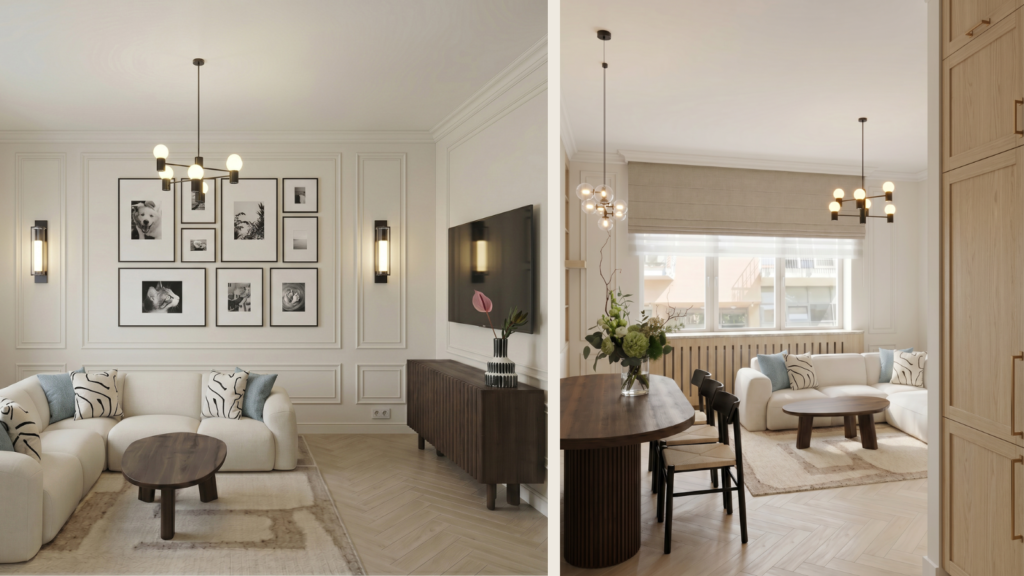
6. The living room, where spatial continuity comes into its own
It is in the living room that the sense of spatial continuity, which runs through the entire flat, truly comes into its own.
The wall sconces featured in the kitchen and at the entrance reappear here too, gently guiding the eye through the flat. This is not a jarring repetition, but rather a subtle rhythm that ties the various rooms together.
In interior design, it is often not the most important thing for each space to be visually striking in its own right. It is far more important that the rooms flow into one another and that there is a consistent design theme throughout the flat.
The placement of the family photographs in the living room was also a deliberate choice. It was important that these personal mementoes were on display, whilst at the same time not immediately catching the eye upon entering, and not disrupting the atmosphere of the home office areas.
They have thus been given a place in a more intimate, understated setting, where they can truly function as a personal element.
One of the key shifts in the design concept is evident here in the use of materials. Starting with the dining room, we deliberately toned down the dominance of oak, whilst darker shades of wood also feature in the living room. These add depth, contrast and character to the space, whilst not disrupting the calm foundation of the flat.
The living room is thus elegant, cosy and personal all at once. It is not intended to make an impression on its own, but rather to serve as a natural conclusion to the flat as a whole.
What makes the renovation of a private flat stand the test of time?
When renovating a private home, timelessness is not just a matter of style. It is not enough simply to use classic designs, shades of beige or natural materials.
Timelessness lies much more in the fact that space is capable of adapting.
A child’s bedroom is timeless if it is not designed for just one age group. A kitchen works well in the long term if it is comfortable to use on a day-to-day basis. A bathroom remains a favourite if it has enough storage space and even the less aesthetically pleasing features are thoughtfully positioned.
A living room becomes a true communal space when it not only serves as a showpiece but also supports family life.
In this Buda project, the classic bourgeois style and contemporary functionality are not at odds with one another. Rather, they complement each other. The stucco, wall sconces, beige-oak finishes and delicate mouldings lend a sense of tranquillity, whilst the concealed doors, built-in storage, home office solutions and pet-friendly features facilitate day-to-day living.
This is the point at which design ceases to be mere visual spectacle and becomes a real home.
Summary: a classic character, a modern lifestyle
A renovation of a private flat It is truly successful when it does not seek to erase the flat’s past, yet does not remain stuck in it either. The aim is to strike a balance where the classic features are preserved, whilst every detail of the space responds to the demands of modern life.
In this home, every room is part of the same story.
The children’s room has been designed with the long term in mind.
The bathrooms have been given new functions.
The bedroom is both a place to relax and a hidden home office.
The kitchen is minimalist, yet very practical.
In the dining room, storage becomes almost invisible.
In the living room, all the motifs that run through the flat come together.
This project clearly demonstrates that what makes a home truly personal is not that it is built using standard solutions, but rather the way the space responds to the rhythm of life, habits, future plans and small, everyday needs of those who live there.
If Are you thinking of a similar conversion?, it’s worth thinking about right at the start of the planning stage how you’d like to use your home, not just now but years from now as well.